
The best types of window tint for commercial buildings fall into five main categories: solar control film, security film, decorative film, ceramic film, and low-emissivity (low-e) film. Each serves a different primary function, and choosing the wrong one for your building’s orientation, climate, or occupancy type will cost you money and performance.
Window film is not a one-size-fits-all product. A south-facing glass curtain wall in Phoenix, AZ has different demands than a street-level retail storefront in Chicago, IL, and treating them the same way is one of the most common mistakes building managers make.
Who this is for: This article is written for commercial property owners, facilities managers, and building tenants in the United States who are actively selecting window film for an existing or new commercial space.
Not for: Residential homeowners looking for home window tinting advice, or anyone researching automotive tint.
Key Takeaways
- Solar control film is the most cost-effective starting point for most commercial buildings focused on energy savings.
- Ceramic film offers superior heat rejection without signal interference, making it the right call for office spaces with heavy Wi-Fi and cellular dependence.
- Security film does not block much heat or glare, so pairing it with a solar control layer is standard practice for retail and banking facilities.
- Low-e film is best suited for buildings in mixed climates where both summer cooling and winter heating costs are real concerns.
- Decorative film adds privacy and branding value but should not be confused with films that offer meaningful UV or heat protection.
- Visible Light Transmission (VLT) percentage is the single most important spec to verify before purchasing any commercial film.
Solar Control Film: The Workhorse for Energy Savings
Solar control film is the most widely installed type across American commercial buildings, and for good reason. It targets infrared radiation, the part of sunlight responsible for heat buildup, while still allowing a usable amount of visible light through the glass. Quality products from manufacturers like 3M, Llumar, and Eastman reject between 40% and 79% of solar heat depending on the film’s specifications.
The practical impact on energy bills is real. Buildings in Sun Belt states like Texas, Florida, and Arizona see the most dramatic reductions because HVAC systems work hardest in those climates. If you want to understand how commercial window tinting reduce energy cost works at the system level, the relationship between reduced solar heat gain and lower cooling load is the core mechanism.
The trade-off: darker solar control films can make interior spaces feel cave-like if the building already has limited natural light. Films with a VLT below 20% will often trigger complaints from occupants. For north-facing facades or interior offices with no direct sun exposure, solar control film may deliver little measurable return.
A note on reflectivity: many solar control films have a mirrored exterior appearance, which some municipalities regulate under local building codes. Always confirm with your city’s planning department before installation.
Ceramic Film: Performance Without the Signal Penalty
Ceramic film uses non-metallic, nano-ceramic particles to block heat and UV radiation. It rejects up to 80% of infrared heat in some formulations while maintaining a neutral, low-reflectivity appearance. Because it contains no metal, it does not interfere with cellular signals, GPS, or Wi-Fi, which matters enormously in office environments loaded with connected devices.
In practice, ceramic film is the most common upgrade request from companies moving into Class A office space. The higher upfront cost (typically $8 to $14 per square foot installed, depending on market and film grade) puts some building owners off, but over a five-year horizon it often closes the gap through reduced HVAC wear. For a detailed breakdown of the broader advantages, reviewing the 7 benefits of commercial window tinting gives useful context on where ceramic film sits in the value stack.
The catch: ceramic film does not provide the same level of shatter resistance as security film. If physical protection is a priority alongside heat rejection, a dual-layer approach adds cost and complexity.
Security Film: Protection First, Comfort Second
Security film is a thicker polyester laminate, typically 4 mil to 14 mil, designed to hold shattered glass together after impact. It is standard in banks, government buildings, schools, and retail locations with smash-and-grab risk. The commercial window tinting for businesses that prioritize safety over aesthetics almost always include security film in their specification.
What most people get wrong about security film: it does very little for heat rejection or glare. Its primary job is to prevent glass from becoming a projectile or an easy entry point. Building managers who install security film expecting energy savings are going to be disappointed.
The right application is pairing security film with a solar control layer. Some manufacturers produce combination products, but standalone security film without an additional solar layer is essentially transparent protection with no thermal benefit.
Installation method matters here. Security film must be anchored to the frame with an attachment system (C-Bond or frame sealant) for it to actually contain glass during a blast or high-impact event. Film that is simply adhered to the glass surface will peel away from the frame on impact, defeating the purpose.
| Film Type | Heat Rejection | UV Block | Shatter Resistance | Signal Impact | Avg. Installed Cost ($/sq ft) |
|---|---|---|---|---|---|
| Solar Control | High (40-79%) | Up to 99% | Low | None | $4 to $9 |
| Ceramic | Very High (up to 80%) | Up to 99% | Low | None | $8 to $14 |
| Security | Minimal | Moderate | Very High | None | $6 to $12 |
| Low-E | Moderate (both directions) | Up to 99% | Low | None | $7 to $13 |
| Decorative | Low | Low to Moderate | Low | None | $3 to $8 |
Low-E Film: The Smart Choice for Mixed Climates
Low-emissivity film works differently from straight solar control film. It reflects radiant heat in both directions: outward in summer to block solar gain, and inward in winter to retain interior heat. This dual-direction performance makes it particularly effective in cities like Chicago, Denver, Kansas City, and other markets where both summer cooling and winter heating costs are significant line items on an operating budget.
The commercial window tinting office buildings that deliver the best year-round return on investment in four-season climates tend to specify low-e products for this reason. The National Fenestration Rating Council publishes standardized ratings for window film thermal performance, and low-e films generally carry the strongest winter U-factor improvements of any film category.
The limitation: low-e film performs below expectations in climates where winter heating is minimal. In Miami, Houston, or San Diego, the winter heat-retention benefit is essentially irrelevant. Building owners in those markets should stick with high-rejection solar or ceramic film and save the low-e premium for where it actually matters.
Decorative Film: Privacy and Branding, Not Performance
Decorative film covers frosted, patterned, and digitally printed films used for privacy partitions, conference room glass, and branded storefronts. It is not a performance product. It will not meaningfully reduce heat or glare, and anyone selling it as an energy solution is overstating its capabilities.
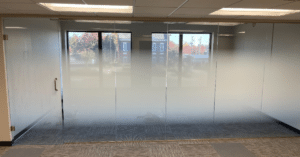
Where decorative film earns its place: privacy without construction. Converting a glass-walled conference room from clear to frosted using film costs a fraction of installing structural partition walls, and it can be removed without damaging the glass. For retail, digitally printed window graphics create storefront presence that standard signage cannot replicate.
One real-world pattern worth noting: office designers frequently combine decorative film on interior partitions with solar control or ceramic film on exterior glazing. The two serve entirely different functions and do not compete. The comparison between commercial window tinting vs blinds becomes especially relevant for interior partitions, where decorative film often wins on cost, maintenance, and longevity.
The U.S. Department of Energy notes that window films in general can contribute meaningfully to building energy efficiency, but decorative film is the category with the smallest thermal contribution in that mix.
How to Match Film Type to Your Building’s Needs
Selecting the best types of window tint for commercial buildings requires three inputs before you can confidently specify a film: glass orientation (which direction your largest glazed facades face), climate zone (the DOE’s building energy codes map is a reliable reference), and occupancy type (what happens inside the building drives the priority order between heat, glare, privacy, and security).
How window tinting protects office furniture is a consideration that often gets overlooked in the initial specification conversation. UV-blocking film in the 99% range, available in both solar control and ceramic categories, prevents accelerated fading of flooring, upholstery, and artwork, an ongoing cost that adds up quietly over five to ten years.
The International Window Film Association maintains a database of certified installers and can help verify that a contractor is working with films that meet ANSI/IWFA standards, which is especially important for security film applications where installation method directly affects performance.
| Building Type | Recommended Film | Secondary Option | Avoid |
|---|---|---|---|
| Office tower, Sun Belt | Ceramic or Solar Control | Low-E | Decorative only |
| Retail storefront | Security + Solar Control combo | Ceramic | Low-E (overkill) |
| Office tower, Midwest/Northeast | Low-E | Ceramic | Solar Control alone |
| Government/school facility | Security film (anchored) | Ceramic | Decorative |
| Hospitality/hotel lobby | Decorative + Solar Control | Ceramic | Security film (aesthetics) |
Verifying Quality Before You Sign a Contract
Film specification sheets are your best protection against underperformance. Any reputable commercial film installer should provide third-party test data, not just marketing claims, showing Solar Heat Gain Coefficient (SHGC), VLT percentage, UV rejection rate, and infrared rejection rate. The Lawrence Berkeley National Laboratory’s window film research provides publicly available performance data that you can use to cross-check manufacturer claims.
What usually trips building owners up at this stage: confusing total solar energy rejected (TSER) with infrared rejection. Some manufacturers advertise infrared rejection numbers that sound impressive but reflect only a narrow band of the solar spectrum. TSER is the more comprehensive and honest metric for evaluating heat performance across all solar wavelengths.
Warranty terms are the other checkpoint. Quality commercial films from established manufacturers carry warranties of 10 to 15 years on the film itself. Installation labor warranties vary by contractor, but anything under two years on workmanship should be a point of negotiation before you sign.
The pattern across well-managed commercial properties: film specification decisions made collaboratively between the building owner, the HVAC engineer, and a certified film installer tend to outperform decisions made by any one party alone. Bringing your mechanical engineer into the conversation about solar heat gain targets before selecting a film category takes an extra meeting but prevents expensive re-specification later.## Frequently Asked Questions
Q: How long does commercial window tint last on a large office building?
Most quality commercial window films last between 10 and 15 years when professionally installed on interior-facing glass surfaces.
Exterior-mounted films have a shorter lifespan, typically 5 to 10 years, because they face direct weathering from rain, UV exposure, and temperature swings. Manufacturer warranties from brands like 3M and Llumar cover film degradation such as bubbling, peeling, and color shift, but those warranties are only valid when a certified installer applies the product. If your building uses a pressure-washing service on its facade, confirm with your installer that the cleaning method is compatible with the film adhesive.
Q: Does commercial window film require a permit in the United States?
In most U.S. jurisdictions, window film installation on existing commercial buildings does not require a building permit, but local codes vary significantly.
Some cities regulate the exterior reflectivity of window film because highly mirrored finishes can create glare hazards for neighboring properties and drivers. Cities like San Francisco and Miami have specific glazing reflectivity limits written into their municipal codes. Before installation, contact your local building and planning department to verify whether your chosen film’s reflectivity rating falls within acceptable limits. Historic districts often impose additional restrictions on any visible alteration to a building’s exterior appearance.
Q: Can window tint be applied to double-pane or insulated glass units in a commercial building?
Yes, but only specific film formulations are rated safe for insulated glass units (IGUs), and using the wrong product can cause thermal stress fractures.
Standard solar control films absorb heat and redistribute it into the glass, which can create uneven thermal expansion in sealed double-pane units. This is called thermal seal failure, and it voids most IGU manufacturer warranties. Films rated for IGU compatibility have lower absorption rates and higher reflection ratios that limit heat buildup within the sealed unit. Always request the film manufacturer’s IGU compatibility letter before specifying any product for double-pane commercial glazing. Your glazing contractor should also sign off on the selection.
Q: What is the difference between window tint and window replacement for commercial energy savings?
Window film costs a fraction of full glazing replacement and delivers comparable energy performance improvements in most commercial applications.
Full commercial window replacement runs anywhere from $400 to $1,200 per window unit installed, depending on glass size, frame type, and building access requirements. High-performance solar or ceramic film typically costs $4 to $14 per square foot installed, covering a much larger glazed area for the same budget. The U.S. Department of Energy has noted that window films can reduce solar heat gain by up to 79%, which overlaps significantly with the performance range of many mid-tier replacement window systems. The trade-off is longevity: replacement windows with quality low-e glass can last 20 to 30 years, while film requires replacement every 10 to 15 years.
Q: Does commercial window tinting affect the building’s LEED certification score?
Window film can contribute to LEED certification points, primarily under the Energy and Atmosphere and Indoor Environmental Quality credit categories.
The specific contribution depends on how the film affects your building’s modeled energy performance relative to the ASHRAE 90.1 baseline, which is the energy standard that LEED v4.1 uses as its reference point. Buildings that install high-rejection ceramic or solar control film and can demonstrate a measurable reduction in cooling energy consumption may earn points under the Optimize Energy Performance credit. Indoor glare control from window film can also contribute to Daylight quality credits when it reduces the need for interior shading systems. Engage a LEED Accredited Professional before specifying film if certification points are part of your building strategy, because the documentation requirements are specific.
The Bottom Line on the Best Types of Window Tint for Commercial Buildings
Picking the right film comes down to three things: your climate zone, your glass orientation, and what problem you are actually trying to solve. Solar control and ceramic films handle the majority of commercial applications in the United States, with low-e film earning its premium in four-season markets where winter heating costs are real. Security film is non-negotiable for high-risk occupancies, but it needs a thermal layer alongside it to deliver any comfort benefit. Decorative film is a finishing tool, not a performance product, and should be budgeted separately from your energy strategy.
The best types of window tint for commercial buildings are not always the most expensive options on the spec sheet. They are the options that match your building’s actual conditions, installed by a contractor who can back the work with manufacturer-certified warranties and documented performance data. Your next step is straightforward: pull the solar orientation data for your largest glazed facades, identify your primary goal (energy savings, security, privacy, or a combination), and request written film specification sheets from at least three certified installers before you commit to any product.